AI Grant Applications Are Flooding Your Inbox. Here Is What Funders Should Do Next.
March 26, 2026 · 7 min read
Granted Research Team · Editorial policy
A program officer at a mid-size foundation told us recently that she used to be able to tell within the first paragraph whether an applicant genuinely understood her organization's priorities. Not anymore. Every application that crosses her desk in 2026 reads like it was written by someone who deeply understands her priorities — because it was written by a machine that ingested them.
She is not alone. Across the philanthropic sector, funders are experiencing something that does not yet have a clean name but is already reshaping how grantmaking works: the collapse of signal in the grant application.
The Volume Problem Is Already Here
The numbers tell a story that most program officers already feel in their inboxes. According to recent surveys, nearly 59% of grant seekers now use AI tools — regularly or occasionally — in writing their applications. At NIH, preliminary data published in Nature showed that proposals drafted with AI assistance actually win funding at higher rates than those written without it. The catch: those same proposals score lower on novelty and tend to propose research that looks strikingly similar to previously funded work.
This is not a future problem. It is a current one. If your foundation received 400 applications last cycle, the question is not whether some were AI-generated. The question is how many were not.
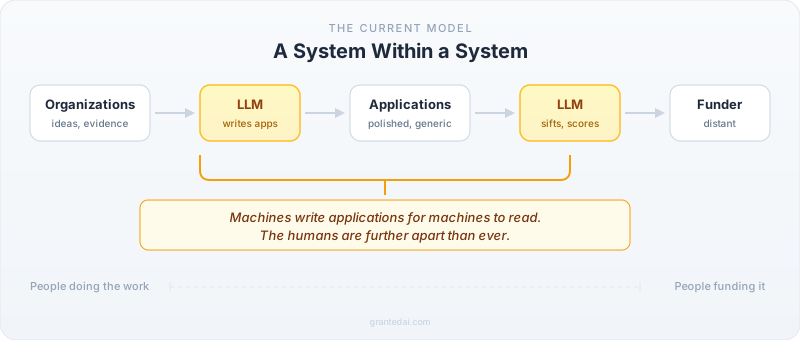
The instinctive response has been predictable: use AI on the other side too, to sift and score. Grants management platforms are racing to add AI-powered application parsing. The result is what one observer called "a system within a system" — machines writing applications for machines to read, with the humans who are supposed to be at the center of the relationship getting pushed further apart.
Why AI Detection Is a Dead End
The first question every funder asks is: can we detect which applications were written by AI? The short answer is no — not reliably, and not in a way that would survive legal or ethical scrutiny.
AI detection tools operate on statistical patterns in text. They are unreliable with short documents, produce false positives on non-native English speakers, and are trivially defeated by a single editing pass. More fundamentally, penalizing "AI-written" applications creates an absurd incentive structure. A brilliant researcher who uses AI to clean up their prose gets flagged. A mediocre applicant who happens to write fluently does not. You are no longer evaluating the quality of the proposed work — you are evaluating the provenance of the sentences describing it.
NIH tried a different angle: capping each investigator at six applications per year and prohibiting proposals "substantially developed" by AI. The cap addresses volume but not quality. The AI prohibition is functionally unenforceable — NIH itself has acknowledged the difficulty of defining where "AI-assisted" ends and "AI-developed" begins. Only 1.3% of applicants were submitting more than six proposals anyway.
Detection is a dead end because it treats AI authorship as the problem. The actual problem is that applications — regardless of who or what writes them — have become a poor way to distinguish organizations that will create impact from those that will not.
Grant Applications Were Already Broken. AI Just Proved It.
This is the uncomfortable truth that the AI wave has exposed: the grant application was never a great tool for identifying the best organizations. It was a test of writing ability, compliance knowledge, and institutional resources. Before AI, the organizations that won grants were disproportionately those that could afford professional grant writers, had development staff with decades of experience navigating federal and foundation systems, and had the institutional knowledge to translate genuine community impact into the specific language reviewers expected.
Small grassroots organizations — often the ones closest to problems and most effective at solving them — routinely lost to larger organizations with polished proposals and weaker track records. Everyone in philanthropy knows this. The application format persisted because there was no better alternative at scale.
AI has not broken the grant application. It has democratized access to polished writing, which was previously a privilege. In doing so, it has stripped away the one thing applications were actually good at: filtering by effort and institutional capacity. What remains is a format that tells you very little about whether an organization can deliver on its promises.
The question funders should be asking is not "how do we fix the application?" It is "what would we use instead if we were designing this system from scratch?"
What Forward-Thinking Funders Are Doing Instead
Several approaches are emerging, each addressing a different piece of the problem.
Simplified entry points. Some funders are replacing full applications with minimal letters of inquiry — a short description of the organization, the proposed work, and the funding need. The LOI is not a test of writing. It is a signal of alignment. Full proposals come later, by invitation, only from organizations that clear the initial threshold. The Lumina Foundation has experimented with this approach, and the result is less time wasted on both sides.
Trust-based and relational models. The trust-based philanthropy movement, championed by organizations like the Trust-Based Philanthropy Project, advocates for multi-year unrestricted funding, simplified reporting, and relationships built over time rather than evaluated through periodic competitions. Foundations like the Meyer Memorial Trust moved to invitation-only grantmaking even before the AI wave — driven not by technology but by the recognition that open competition placed unfair burden on under-resourced applicants.
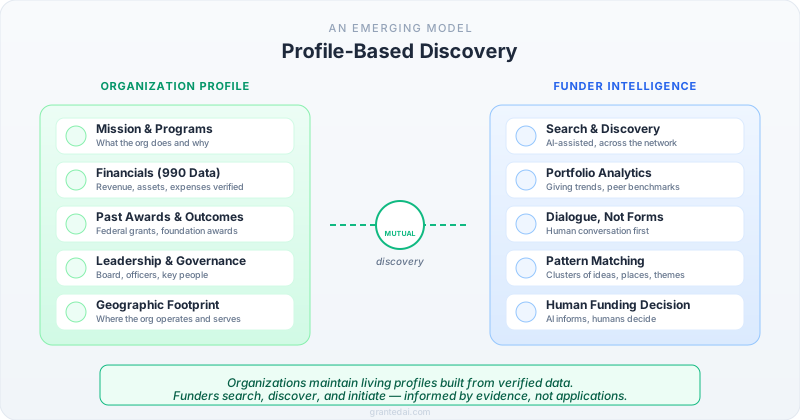
Proactive grantee discovery. This is the most consequential shift, and the one least discussed. Instead of designing a call for proposals and waiting to see who applies, a growing number of program officers are researching organizations directly — reviewing public data, analyzing past funding patterns, and identifying potential grantees before any application exists. They are doing informally what recruiting transformed formally over the past decade: moving from "post a job and wait" to "search, identify, and reach out."
The data infrastructure to support this shift already exists in fragments. IRS 990 filings reveal organizational finances, leadership, and program expenses. Federal award databases show track records of grant performance. Foundation giving histories reveal who funds whom. Past winner data shows which organizations have already earned the trust of peer funders. What is missing is a way to search across all of this in a single place, structured for the specific needs of a program officer trying to find the right grantee — not a grant seeker trying to find the right funder.
Funders and Grantees Finding Each Other
The grant world is arriving at the same inflection point that recruiting reached a decade ago. Before LinkedIn Recruiter, companies posted jobs and waited for applicants. The best candidates — the ones already employed and not actively looking — never applied. Recruiting was transformed when it flipped from reactive to proactive: employers searched for talent based on track records, skills, and alignment, then reached out directly.
Grant funding is overdue for the same shift. The best organizations — the ones deeply embedded in their communities, running programs that work, led by people who spend their time on impact rather than proposals — are often the worst at grant applications. They do not have development departments. They do not know the jargon. They are too busy doing the work to write about doing the work.
A discovery model changes this. Instead of requiring organizations to prove themselves through a written test, funders can evaluate what matters: track record, financial health, community rootedness, leadership stability, and alignment with funding priorities. This data already exists in public records. The missing piece is structure and searchability.
This is not about replacing human judgment with algorithms. The funder's role becomes more important, not less — but the judgment shifts from "which proposal is best written?" to "which organization is best positioned to create impact?" That is a better question, and it leads to better funding decisions.
The equity implications are significant. In the current model, well-resourced organizations with professional grant writers have a structural advantage. In a profile-based model, the advantage shifts toward organizations with strong track records and genuine community impact — regardless of their writing capacity. Designed well, this approach can surface small, grassroots organizations that the application model systematically excludes.
What You Can Do Today
If you are a program officer or foundation leader reading this, you do not need to wait for the sector to transform itself. There are concrete steps you can take now.
Audit your applications for signal. Read your last funding cycle's winning applications alongside the runners-up. Can you reliably distinguish the organizations that will deliver from those that merely wrote well? If not, your application format is selecting for the wrong thing.
Explore what public data already exists about your applicants. IRS 990 filings, federal award histories, and past funder relationships are all available — increasingly in structured, searchable form. You can learn more about an organization from its ten-year track record than from a fifteen-page proposal.
See what grantees already see when they research your foundation. Platforms like Granted aggregate funder data — your giving history, program focus, past recipients, geographic patterns — into public profiles that grant seekers use to evaluate whether to apply. Look up your foundation's profile to see how you appear to the organizations you want to reach. If the information is outdated or incomplete, you can claim and update it.
Experiment with a discovery round. Before your next funding cycle, spend a few hours searching for organizations that match your priorities — not from your existing pipeline, but from the broader landscape. You may find organizations doing extraordinary work that would never have found your RFP.
The grant application is not dead yet. But it is no longer the best tool for the job it was designed to do. Funders who recognize this early — who invest in discovery and relationships over volume and compliance — will find better grantees, make better decisions, and ultimately create more impact with every dollar they deploy.
Looking for organizations aligned with your mission? Explore funder profiles on Granted to see what grantees see — and discover who's already watching.